

 |
Perclose ProStyle |
Clinical Evidence
The studies shown below are examples of the safety and benefits that Perclose ProStyle™ Suture-Mediated Closure and Repair (SMCR) System may provide patients who have undergone cardiac arrhythmia treatments with multiple common femoral venous access sites.
Perclose Multi-Access Duplex Ultrasound (DUS) IDE Trial
Vascular Closure for Cardiac Ablation Registry (VACCAR)
Emory School of Medicine (ESM) Study
Santa Barbara Cottage Hospital (SBCH) Study
EVEREST II / REALISM Continued Registry Study
Vascular Closure for Cardiac Ablation Registry (VACCAR)
Emory School of Medicine (ESM) Study
Santa Barbara Cottage Hospital (SBCH) Study
EVEREST II / REALISM Continued Registry Study
Perclose Multi-Access Duplex Ultrasound (DUS) IDE Trial
Background
This trial was a prospective, single arm, multi-center, descriptive study of 36 patients enrolled from September, 2021 to May 2022. Femoral duplex ultrasound is not routinely utilized during ablation procedures and is often only used when access-site related complications are visible and/or symptomatic. To evaluate the safety of multiple access site closure in a single vein with PercloseTM, patients underwent duplex ultrasound to assess the presence of asymptomatic or non-visible complications.
Methods
All subjects underwent routine cardiac ablations as standard of care. A total of 36 patients were enrolled with an average of 3.5 access sites ranging in size from 8-15F. 14 patients underwent cryoablation only, 21 patients underwent radiofrequency ablation only, and 1 patient underwent both types of ablation procedures. Patients received a femoral vein duplex ultrasound of their access sites at discharge and, for those with asymptomatic or non-visible complications, a second duplex ultrasound at 30 day follow up.
Endpoints
Major or minor vascular complications detected by scheduled duplex ultrasound at discharge and at 30 days in subjects with asymptomatic/non-visible complications.
Key Clinical Outcomes
|
100%
Freedom from major access site-related complications deteted symptomatically or by duplex ultrasound at discharge and at 30 days
|
6.5* Minutes
to hemostasis per patient with 3.5 access sites on average
|
100%
of minor complications were confirmed resolved at 30 days by duplex ultrasound |
|
99.2%
Perclose success rate per access site
|
*Median reported
Vascular Closure for Cardiac Ablation Registry (VACCAR)
Background
Retrospective, chart review, subject-level study of 434 atrial fibrillation patients from October 2017 to November 2020 to evaluate differences in rates of vascular and bleeding complications when comparing Perclose™ devices, manual compression, and Fo8, to achieve hemostasis post ablation procedure.
Methods
Charts of 434 atrial fibrillation patients were reviewed (64% cryoablation, 36% radiofrequency). Perclose™ was utilized with 75 of the patients while a 156 were treated with manual compression and 203 with Figure of 8. Per institutional protocol, the right femoral vein was used for the first three access sites, with additional access sites placed in the left femoral vein. There was a mean of 3.6 access sites per subject. Performance and safety endpoints were evaluated in hospital – there was no 30 day follow up in this study.
Endpoints
Freedom from femoral vein access-related major vascular complications at discharge. Additional parameters included time to hemostasis and time to ambulation.
Key Clinical Outcomes
|
100%
Freedom from major access site-related complications at discharge
|
4%
Minor complication rate
|
Reduced
Time to hemostasis and ambulation compared to manual compression
|
Emory School of Medicine (ESM) Study
Background
Prospective, randomized controlled trial to evaluate the safety and effectiveness of Perclose™ in comparison with manual compression. A total of 109 patients (55 Perclose patients*, 54 manual compression patients) were enrolled across three sites from January, 2020 to December, 2020.
Methods
Subjects underwent routine ablation for AF as standard of care (66% cryoablation, 34% radiofrequency) and were followed through for 30 days before exiting the trial. All access sites in the closure arm were treated with one PercloseTM, regardless of sheath size as standard. 52 out of the 53 closure patients had at least one sheath larger than 8F with an average sheath size of 10.24F and sheath sizes ranging from 7-16F.
Subjects underwent routine ablation for AF as standard of care (66% cryoablation, 34% radiofrequency) and were followed through for 30 days before exiting the trial. All access sites in the closure arm were treated with one PercloseTM, regardless of sheath size as standard. 52 out of the 53 closure patients had at least one sheath larger than 8F with an average sheath size of 10.24F and sheath sizes ranging from 7-16F.
Endpoints
The primary safety endpoint was freedom from femoral vein access-related major vascular complications. Secondary endpoints included time to hemostasis and time to ambulation, frequency of access-site related complications, pain, need for post-procedure narcotics, subject satisfaction, cost and overall resource utilization.
The primary safety endpoint was freedom from femoral vein access-related major vascular complications. Secondary endpoints included time to hemostasis and time to ambulation, frequency of access-site related complications, pain, need for post-procedure narcotics, subject satisfaction, cost and overall resource utilization.
Key Clinical Outcomes
|
96.2%
Freedom from major access site-related complications up to 30 days
|
98.7%
Success rate per access site
|
Reduced
Time to hemostasis and ambulation compared to manual compression
|
*Of the 55 subjects enrolled, two were randomized without procedure, therefore, only 53 subjects were assessed for safety endpoints to 30 days
Santa Barbara Cottage Hospital (SBHC) Study
Background
Retrospective, single-arm, subject-level study to evaluate the safety and effectiveness of Perclose™ devices in closure of multiple access sites of the ipsilateral femoral vein following atrial fibrillation (AF). Study included 519 atrial fibrillation patients from November 2016 – March 2020 who had at least one access site closed with a Perclose device and were discharged the same day, with 30-day follow up.
Methods
Right femoral vein was used for access and closure per the site standard with an average of 3.6 access sites per vein. Post-close technique with a single device was used for all access sites, including those above 8F. Access sites ranged from 4-12F.
Endpoints
Freedom from femoral vein access-related major vascular complications at 30 days post-procedure.
Right femoral vein was used for access and closure per the site standard with an average of 3.6 access sites per vein. Post-close technique with a single device was used for all access sites, including those above 8F. Access sites ranged from 4-12F.
Endpoints
Freedom from femoral vein access-related major vascular complications at 30 days post-procedure.
Key Clinical Outcomes
|
99.2%
Freedom from major access site-related complications
|
1
PercloseTM device used with post-close technique for all >8F sheaths
|
EVEREST II / REALISM Continued Registry Study
Background
Hemostasis for large-sized venous access sites is commonly achieved via manual compression (MC) or by a subcutaneous figure-of-eight stitch followed by prolonged application of a compression bandage (usually ≥12 hours). However, this combination leads to patient discomfort and extended immobilization, which in turn may lead to additional complications.
Objective
Evaluate the safety and performance of the Perclose ProGlide™ SMC in the closure of the venous access site in subjects treated with a large-caliber femoral vein sheath (24F OD).
Method
A retrospective analysis was performed to evaluate the safety and effectiveness of the Perclose ProGlideTM SMC in closing large-sized venous access sites through a retrospective data collection from the EVEREST II /REALISM Continued Access Registry Study (REALISM). The retrospective analysis included subjects in whom Perclose ProGlideTM was used as the primary method for large bore venous access-site closure during the MitraClip index procedure with a 24F OD vascular sheath.
A retrospective analysis was performed to evaluate the safety and effectiveness of the Perclose ProGlideTM SMC in closing large-sized venous access sites through a retrospective data collection from the EVEREST II /REALISM Continued Access Registry Study (REALISM). The retrospective analysis included subjects in whom Perclose ProGlideTM was used as the primary method for large bore venous access-site closure during the MitraClip index procedure with a 24F OD vascular sheath.
Primary Endpoint
Rate of freedom from major femoral vein access-site related complication at 30 days post-procedure, compared to pre-defined clinical acceptance criteria (≥ 90%).
Rate of freedom from major femoral vein access-site related complication at 30 days post-procedure, compared to pre-defined clinical acceptance criteria (≥ 90%).
Key Clinical Outcomes
|
98.1%
Freedom from major femoral vein access site-related complications at 30 days
|
1.9%
Major complication rate observed with use of 24F OD sheath
|
5.15 minutes**
mean time to hemostasis for patients who received the Perclose ProGlideTM SMC System only
|
**Source: Perclose™ ProStyle™ SMCR System Instructions for Use (IFU). Refer to IFU for additional information.

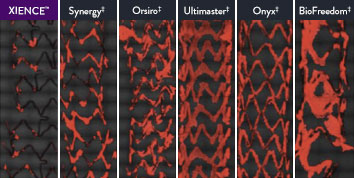
The XIENCE™ Stent is also recognized as being significantly more anti-thrombotic than other DES on the market. As shown in the study findings, XIENCE™ Stent reveals significantly less (p < 0.01) platelet adhesion—shown in red in the confocal microscopy images—than other DES, and platelet adhesion is an important factor in stent thrombosis.*8 These findings suggest that this stent choice “may be ideally suited for very short-term DAPT.”8
*Ex Vivo Swine Shunt Model.

Diamondback 360™ OAS Gives You the Versatility to Treat Challenging Cases
Treat even the most severely calcified lesions, with under 2-minute setup7,8 and predictable procedure times.2
Facilitates antegrade and retrograde treatment of:
- Long, Diffuse Lesions
Successfully treated lesions up to 60 mm in length in real-world study.9 - Heavily Stenosed Lesions
Crossed >99% of lesions with <2% pre-dilatation in the ORBIT II study.1,10 - Nodular Lesions
Effectively treats nodular calcification.5,6 - Ostial Lesions
Safely treats ostial lesions.11-13
Low Profile
6F compatible for femoral or radial access.14
Multiple Vessel Sizes
A single 1.25 mm crown treats vessels 2.5 mm to 4.0mm14
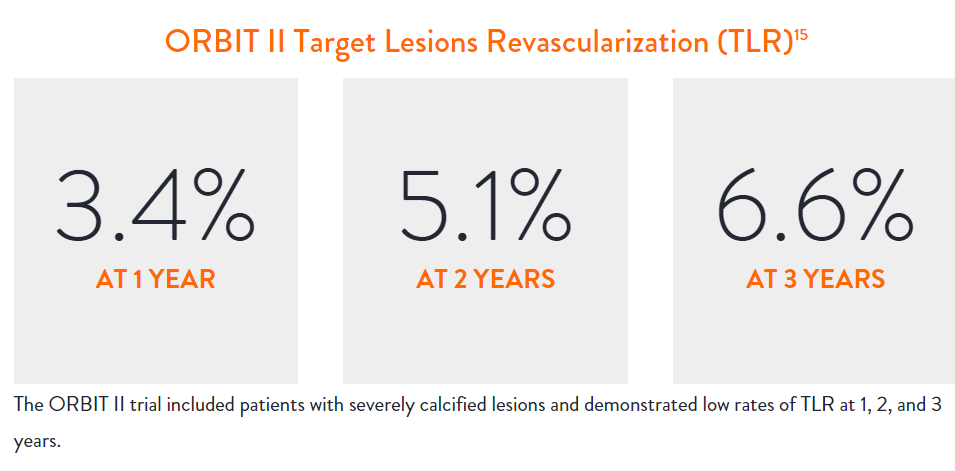
Diamondback 360™ OAS Has Been Proven Effective and Safe in the Treatment of Severely Calcified Lesions.
Extensively studied, and with over 100,000 patients treated,15 orbital atherectomy has been demonstrated to perform effectively and safely in the treatment of severely calcified lesions.
|
|
Proven Safety |
Procedural Success |
Low Q-Wave MI Rate |
>2,200 |
<1% |
97.7% |
0.9% |
|
Patients Across 11 |
Component Angiographic |
Crossing and Stent |
In the ORBIT II |
Sustained Clinical Performance
Data are for ORBIT II TLR in the OA+DES patient cohort.

STOPDAPT 2 Trial Design and Randomization10

Short 1-Month DAPT
- 0 to 1-month: Aspirin + P2Y12
- After 1-month: Clopidogrel monotherapy

12-Month DAPT
- 0 to 1-month: Aspirin + P2Y12
- 1 to 12-month: Aspirin + Clopidogrel
- 12 to 60-month: Aspirin monotherapy

- Successful PCI using CoCr everolimus-eluting stent: XIENCE™
- Eligible for DAPT (aspirin/P2Y12 receptor blocker) for 1 year

- Patients who need oral anticoagulants
- History of intracranial bleeding
- Major in-hospital complications (MI/stroke/major bleeding)
STOPDAPT Study: XIENCE™ Stent with 3-Month DAPT Is Feasible9
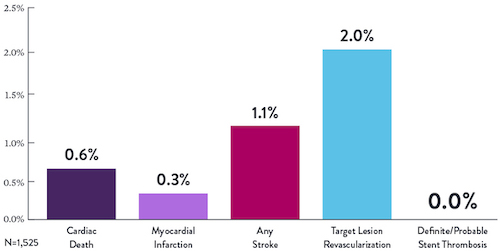
STOPDAPT9 was the first prospective trial to study DAPT cessation at 3 months after implantation. Among other 1-year outcomes, the XIENCE™ Stent rate of stent thrombosis was 0.0%.
STOPDAPT Study Demonstrates Feasibility of XIENCE™ Stent with 3-Month DAPT9
STOPDAPT-3 Trial Design and Randomization11
- PCI with planned exclusive use of CoCr-EES (XIENCE)
- ACS presentation or ARC-HBR
- Eligible for DAPT (Aspirin/P2Y12inhibitor) for 1 month
Study design and Randomization
Group 1:
0 to 1-month: Aspirin + P2Y12 (Prasugrel)
After 1-month: Clopidogrel monotherapy
Group 2:
0 to 1-month: P2Y12 (Prasugrel)
After 1-month: Clopidogrel monotherapy
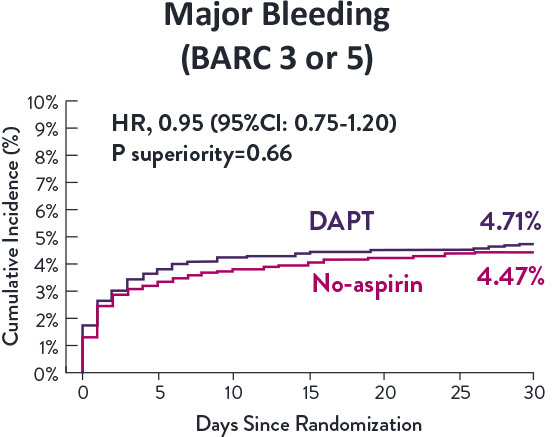
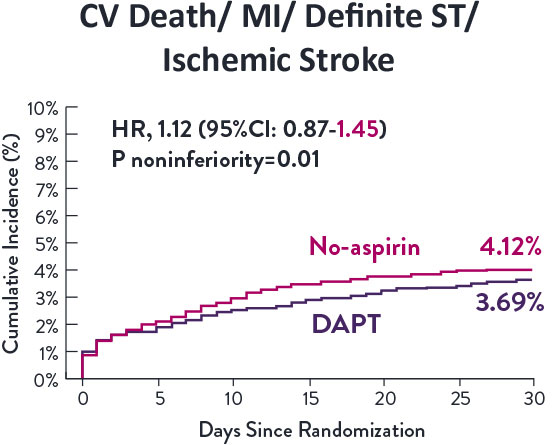
STOPDAPT-3 Trial 11 was designed to explore 0-month DAPT* (SAPT˄ using only P2Y12 inhibitor) for ACS and HBR patients.
Though the results are comparable for both bleeding and ischemic events for DAPT and SAPT arms, the study did not meet its endpoint and concluded to use DAPT for 1 month after PCI.

XIENCE™ Stent remains the ONLY DES with the shortest DAPT indication, as short as 28 days.12



MAT-XXXXXXX